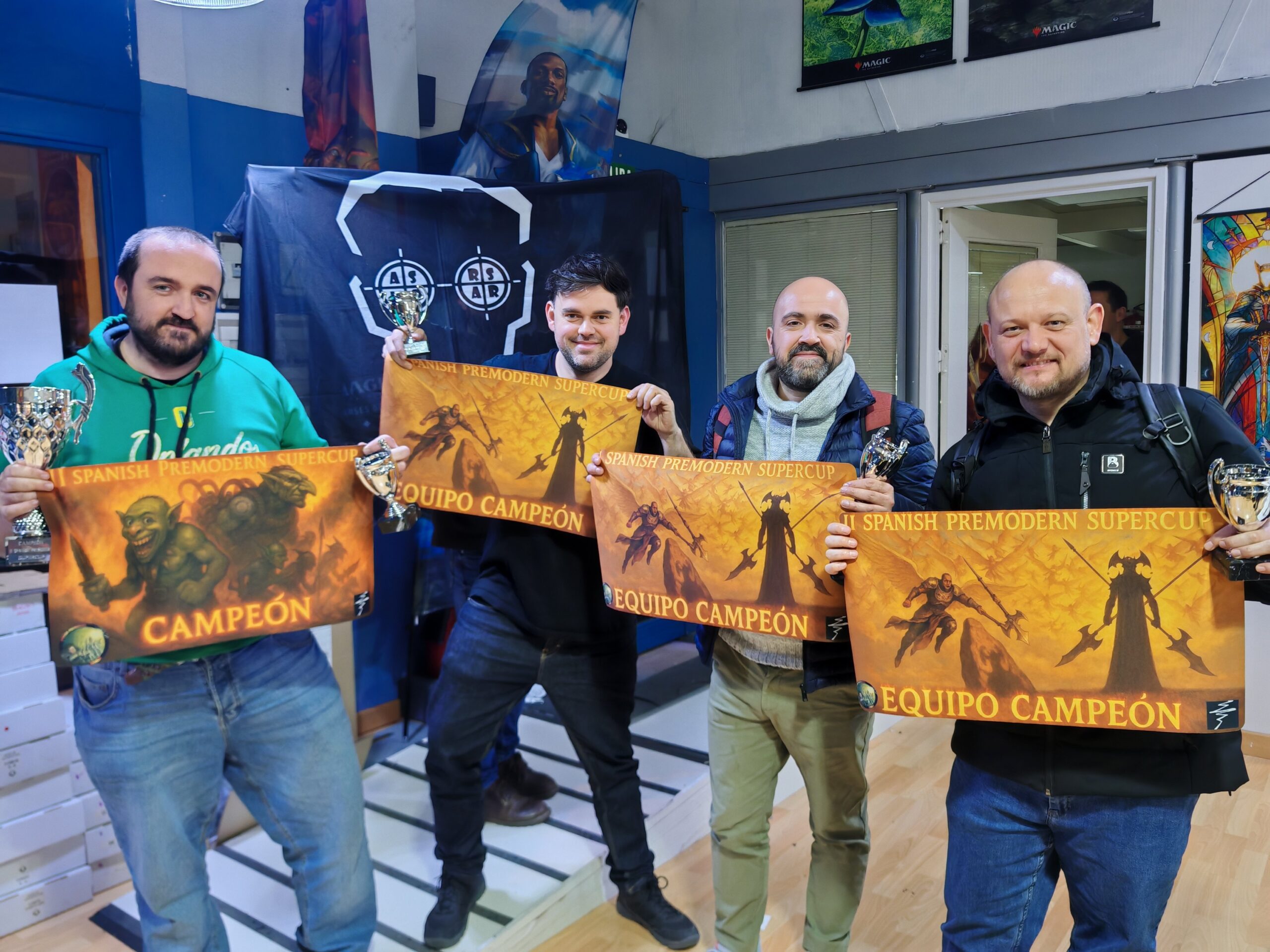
The Spanish Super Cup 2026 was a Premodern tournament restricted to qualified players. There were 64 players, with 4 representatives from each of 16 communities across the Iberian Peninsula. It took place on January 17th at Tempest Store.
This event is a particularly clear case study for Top 7.2 for one simple reason: in the last two Swiss rounds, the incentives to keep playing while undefeated were massive. However, several strong players acted out of habit, as if this were a traditional Top 8 tournament. In this specific event, that choice was punished immediately and measurably.
What Top 7.2 rewards
In Top 7.2, the player who finishes 1st after Swiss gets a bye straight to the semifinals, but only if they won the last two Swiss rounds. If they draw or lose either of those rounds, the bye disappears and the playoff becomes a normal Top 8.
Here is the heuristic you should internalize:
In Top 7.2, intentionally drawing while undefeated is always incorrect.
Not because “drawing is bad”, but because the structure is designed so that drawing while undefeated makes you give up a very large portion of your probability of winning the tournament.
After Round 4: three players at 4-0, with two rounds left
After Round 4, three players were on 12 points (4-0): Virgilio Domínguez, Sergio Molero Henares, and Luís Pedro Santos.
In a traditional Top 8 structure, the correct play for them is to intentionally draw in the penultimate round, with the plan to intentionally draw again in the last round, locking up their playoff spots and avoiding unnecessary risk. In Top 7.2, the correct decision is different: you should play, because what matters is not only making the cut, but keeping the bye alive.
Round 5: the first mistake, drawing at 4-0
In Round 5:
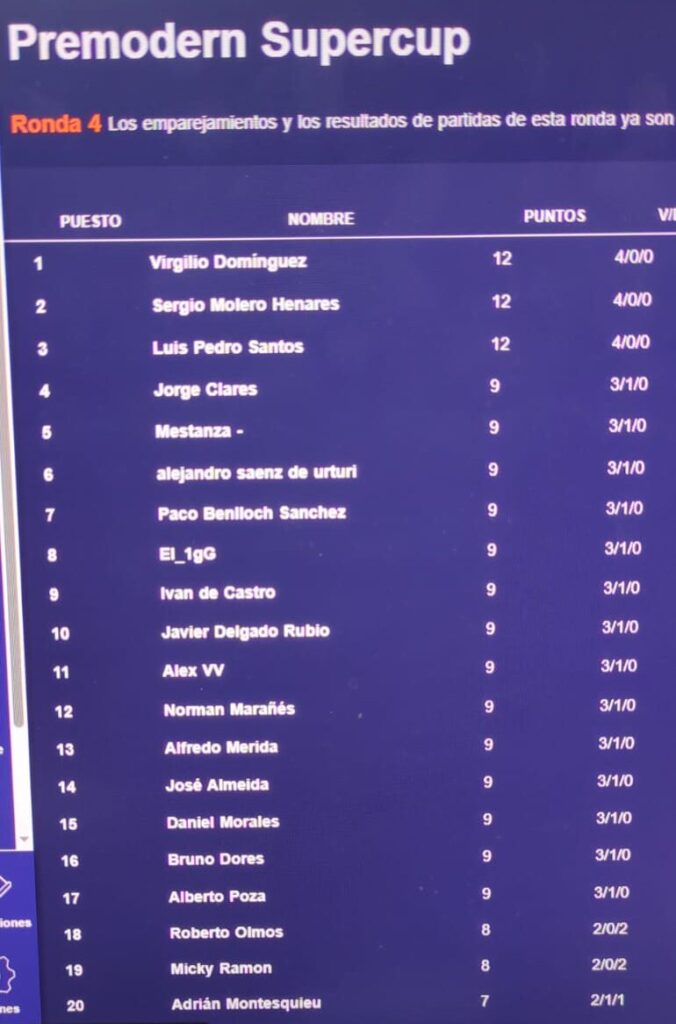
- Table 1: Sergio Molero Henares (12) vs Virgilio Domínguez (12), they intentionally drew.
- Table 2: Luís Pedro Santos (12) vs Alberto Poza (9), they played, Luís won.
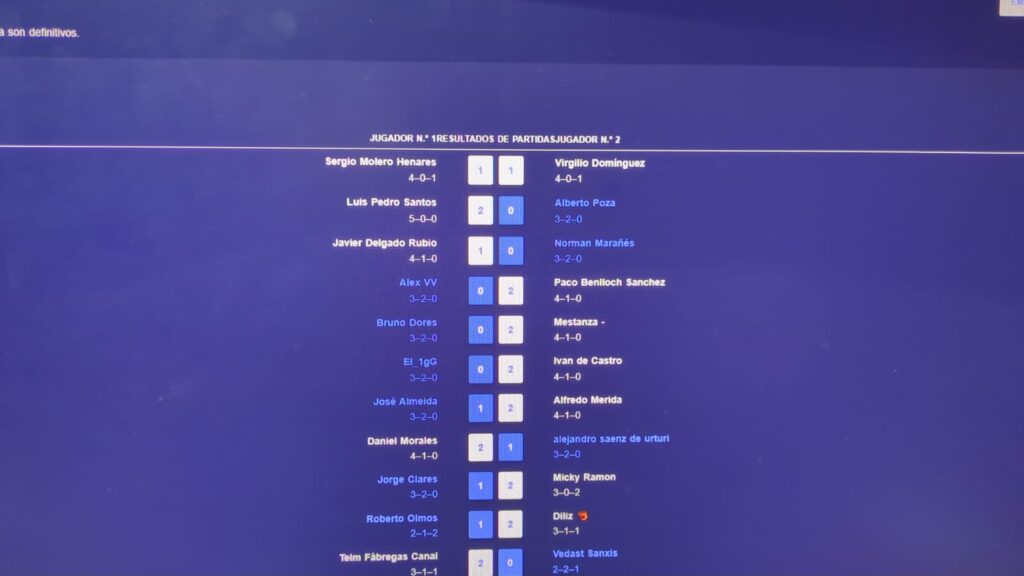
After Round 5, the top of the standings looked like this:
- Luís Pedro Santos, 15
- Virgilio Domínguez, 13
- Sergio Molero Henares, 13
- Javier Mestanza, 12
- Paco Benlloch, 12
- Iván de Castro, 12
- Javier Delgado Rubio, 12
- Alfredo Merida, 12
- Daniel Morales, 12
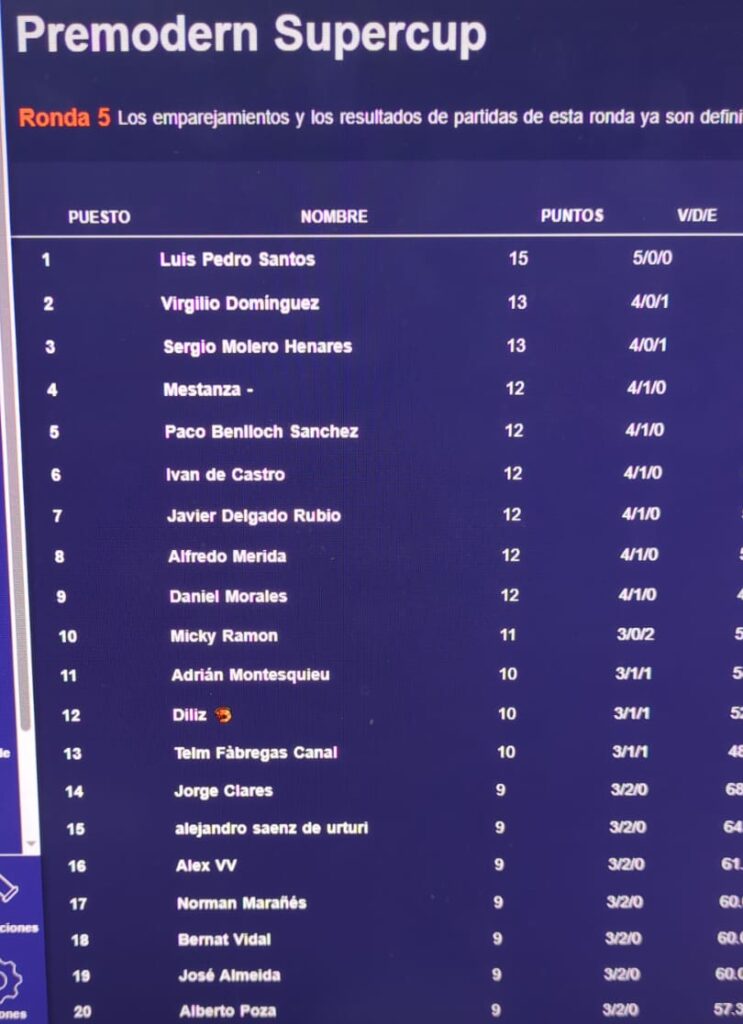
The effect of that intentional draw is immediate: Sergio and Virgilio can no longer obtain the bye in the last round, because the requirement is to win the last two rounds.
How costly is drawing from 4-0?
To quantify it, we use this model:
- In Swiss, if you choose to play, we assume a 50% chance to win the round.
- In elimination, the higher Swiss finisher chooses who plays first. We model “playing first” as a 52% chance to win the match.
Under those assumptions, weighting all outcomes (finishing 6-0 with a bye, versus entering playoffs without the bye in various positions), ChatGPT estimates:
- If you play from 4-0: approximately 15.75% chance to win the tournament.
- If you intentionally draw from 4-0 (therefore giving up the bye): approximately 12.5%.
Difference: 3.25%.
That number is easy to underestimate if you do not translate it. In a 64-player tournament, the average player has a 1/64 chance to win the event. Losing 3.25% is equivalent to losing the “value” of 2.08 tournaments of this size.
Put plainly: it is like qualifying for two events like this one, paying the entry fee, traveling, paying for accommodation and food, and then, once you arrive, deciding to concede every round of the tournament. Twice.
That is the order of magnitude of the mistake of intentionally drawing at 4-0 in Top 7.2.
Round 6: the even bigger mistake, drawing in the final round while undefeated
In Round 6, the key pairings were:
- Luís Pedro Santos (15) vs Virgilio Domínguez (13)
- Sergio Molero Henares (13) vs Javier Mestanza (12)
- Paco Benlloch (12) vs Iván de Castro (12)
What happened? The first three tables intentionally drew.
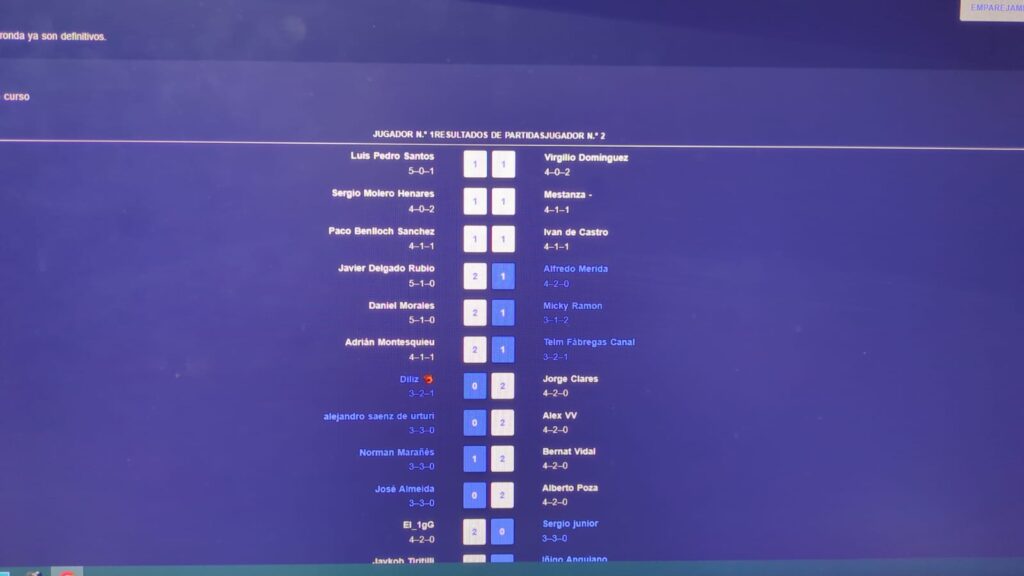
Immediate consequence: nobody can meet the “win the last two rounds” requirement, so there is no bye and playoffs become a normal Top 8. Also, Paco intentionally drew because he already knew Table 1 would intentionally draw. At that point, Top 8 was locked and he would be inside those 8.
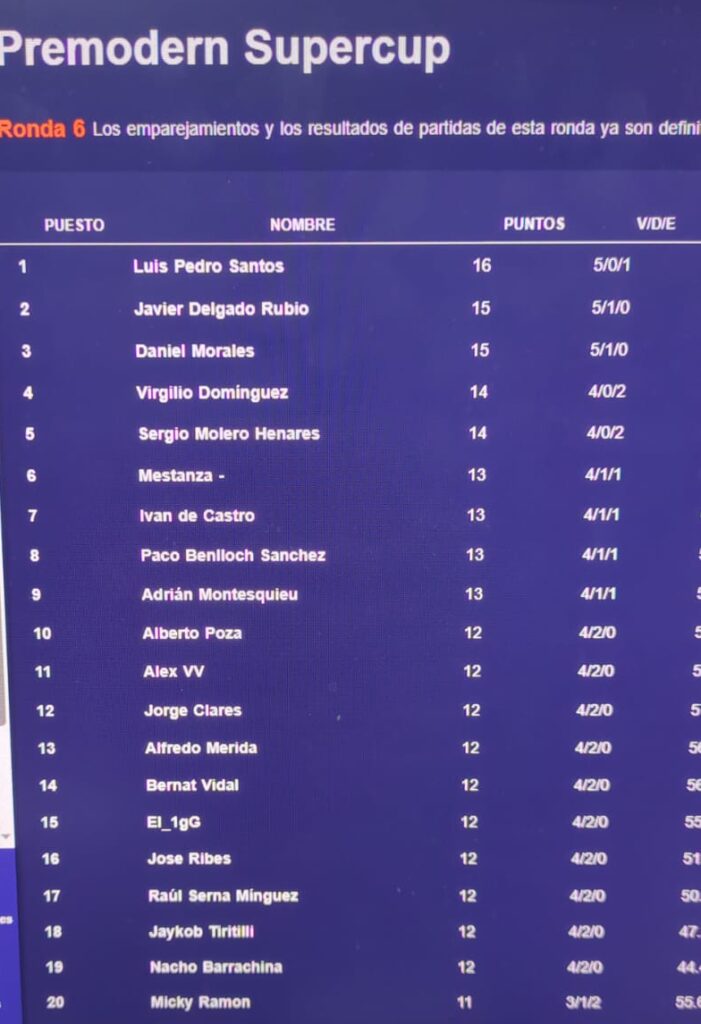
How costly is drawing in the final round while undefeated?
This was the biggest mistake of the tournament in terms of expected value.
If Luís intentionally draws:
- He finishes 1st after Swiss, without a bye.
- His chance to win the tournament, as Swiss #1 in a normal Top 8, is 0.52³ = 14.0608%.
If Luís plays:
- 50% of the time he wins, gets the bye, and his chance becomes 0.52² = 27.04%.
- 50% of the time he loses and, in this context, it is reasonable to assume he finishes 2nd after Swiss, with 13.7683% to win.
Expected value of playing: 20.40415%.
Difference versus drawing: 6.34335%.
Translated: that is equivalent to losing the “value” of 4.06 tournaments of 64 players.
In other words, it is as if Luís had qualified for four events of this caliber, paid entry, travel and accommodation, and then, in all four events, arrived at the venue and signed up for an automatic 0-6 without playing a single game.
This is not a small edge. It is a massive mistake.
The outcome: the 8th seed got in, and won the tournament
With no bye, playoffs were a normal Top 8. That opened the door for the 8th-place player to enter. In this event, the 8th player was Paco Benlloch, a member of the Valencia team, which also finished 1st in the team standings.
And Paco made the most of the opportunity:
- He beat Luís in the quarterfinals, a match that should not have existed if Table 1 had played and Luís had earned his bye, except for the rare case where they played and naturally drew due to time.
- He beat Sergio in the semifinals, one of the players who had been 4-0 and had intentionally drawn incorrectly in Round 5.
- He beat Daniel Morales in the finals.
The story of the tournament is, therefore, a clean case study: the incentives existed and were huge, and ignoring them led to a chain of consequences perfectly aligned with the structure of the system.
Conclusion
The undefeated players who made these choices are strong players. The problem was not “playing poorly”, but applying the correct Top 8 heuristic inside a structure that rewards something else.
Top 7.2 is not trying to magically stop people from drawing. What it does is make drawing while undefeated extremely expensive, and make playing extremely rewarding. That creates an immediate advantage for the players who understand the structure and apply it correctly.
And the practical rule, if you play this structure, is simple:
In Top 7.2, intentionally drawing while undefeated is always incorrect.