
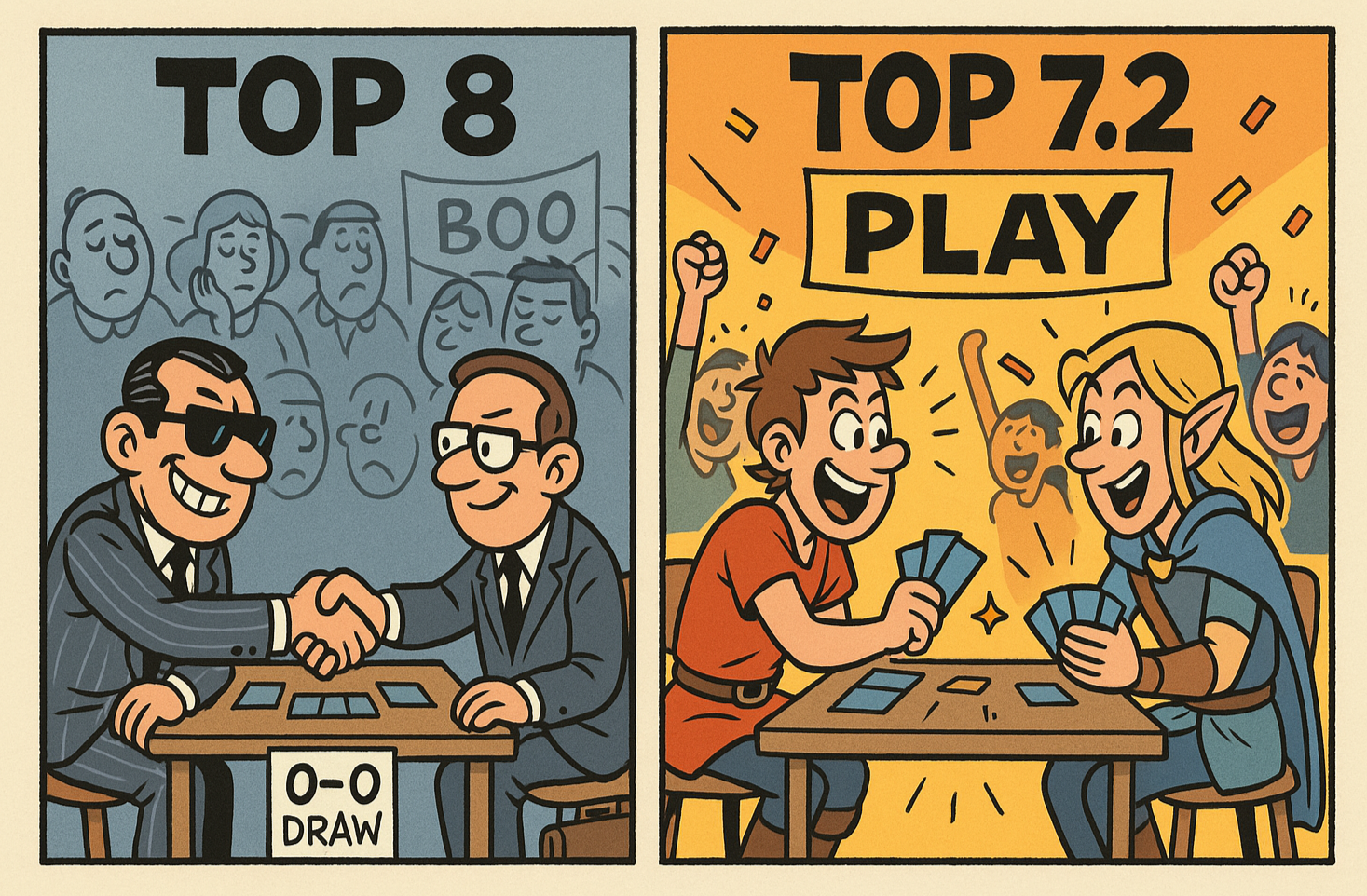
Top 7.2 is a better tournament structure for Magic tournaments. We created it in 2024, Vedast Sanxis and my late friend César Garrido, who disliked structures that made intentional draws the correct play or turned rounds into games where nothing was really at stake. It debuted at the 2024 Old Frame Vintage World Championship on October 19, 2024 in Madrid.
1) Top 8 comes from bridge, not from Magic
Since the first Pro Tour (Junior division, New York 1996), Magic: the Gathering has used Swiss plus Top 8. That structure was copied from contract bridge, where it had been used for decades.
In bridge, finishing high in Swiss grants a large knockout advantage, and matches cannot be pre-arranged or drawn. There, the incentives fit. In Magic, intentional draws are legal and first seed yields little; the incentives break.
2) The Top 8 failure two Swiss rounds before the end
With two Swiss rounds left, there are usually two to four undefeated players. For each undefeated player, the optimal plan under Top 8 is:
- intentional draw in the penultimate round,
- intentional draw in the last round.
Two draws:
- effectively lock a Top 8 spot,
- avoid the risk of losing and missing the cut,
- give up little, because what matters is being inside the eight.
The structure tells the leaders that, once a draw secures Top 8, playing real matches in the final two Swiss rounds is a mistake. Swiss becomes basically a qualifier to a second tournament (the knockout), and your exact Swiss place matters little as long as you qualify.
3) How Top 7.2 works
Top 7.2 keeps the same Swiss count and the same total elimination rounds as Swiss plus Top 8. It adds one rule after Swiss:
- Take the player who finished 1st after the last Swiss round.
- If that player won both of the last two Swiss rounds:
- they receive a bye to the semifinals,
- seven players (seeds 1-7) enter the playoff.
- If the first player did not win both, we run a normal Top 8.
“7.2” means seven players in the bracket when the condition is met; “.2” refers to the last two rounds.
4) Why Top 7.2 is better than Top 8
Table 1 plays instead of drawing.
At table 1 in the last two Swiss rounds it is optimal to play. Playing maximizes the chance to reach semifinals and to win the tournament; double-drawing gives up that edge. As a result, table 1 actually plays those rounds. In many cases other top tables (for example 3-4) also stop being correct to lock eighth with a draw, because eighth is almost never enough.
Swiss truly matters.
With Top 8, Swiss is basically just a qualifier to a second tournament. With Top 7.2, the best Swiss performer who wins the last two rounds gains a large structural reward: one fewer elimination match to win the event. Swiss stops being “just to get in” and starts deciding a big advantage inside the bracket.
Same rounds, guaranteed extra real matches.
Top 7.2 removes one quarterfinal (1 vs 8). In exchange, when the bye happens, we guarantee at least two extra real matches compared to Top 8: table 1 in the penultimate and last Swiss rounds, which under Top 8 would be intentional draws because that is the correct play there. Choosing to play instead would be an error under Top 8.
5) Intentional draws under Top 7.2
Top 7.2 does not remove every intentional draw. In the last round at some lower tables a draw can still be optimal.
What it fixes is the worst place for a draw: table 1 in the last Swiss rounds. There you always have the two best records facing each other. Those are the games players come to tournaments to play and the games spectators most want to watch, and not because anyone is forced, but because the structure makes playing optimal.
6) Recommended round counts and Top 15.2
Top 7.2 only defines the cut. Recommended Swiss and playoff rounds by attendance:
| Players | Swiss rounds | Playoff rounds |
|---|---|---|
| 9-16 | 5 | 2 (Top 3.2) |
| 17-32 | 5 | 3 (Top 7.2) |
| 33-64 | 6 | 3 (Top 7.2) |
| 65-112 | 7 | 3 (Top 7.2) |
| 113-128 | 7 | 3 (Top 8) or 4 (Top 15.2) |
| 129-204 | 8 | 3 (Top 7.2) |
| 205-226 | 8 | 3 (Top 8) or 4 (Top 15.2) |
| 227-372 | 9 | 3 (Top 7.2) |
| 373-408 | 9 | 3 (Top 8) or 4 (Top 15.2) |
| 409-682 | 10 | 3 (Top 7.2) |
| 683-744 | 10 | 3 (Top 8) or 4 (Top 15.2) |
| 745-1260 | 11 | 3 (Top 7.2) |
| 1261-1364 | 11 | 3 (Top 8) or 4 (Top 15.2) |
Rows with a single playoff option use Top 7.2. Rows offering “Top 8 or Top 15.2” are ranges where cutting one player with 7.2 could exclude a one-loss player; there you either run a normal Top 8 or, if time allows, Top 15.2 (same idea at Top 16, one extra elimination round).